Showing posts with label Fondant. Show all posts
Fondant 101

Fondant 101

This week is going to be all about fondant here on the Beki Cook's Cakes Blog.

Fondant is everywhere. ALL of the cake shows use - in my opinion - entirely too much fondant. But if you talk to most people, they have rarely, if ever, eaten the stuff. They talk about peeling it off of the cake before eating it. So, what's the point?! Well, it is beautiful! And if you're at all artistic, it's amazing the kinds of 'sculptures' you can do with it.

This post serves as a kind of introduction to fondant. Although, I will recommend that if you really don't know much about fondant, but would like to get into it, take a real class! It's nice to have someone who knows what they're talking about to answer your questions along the way, and help correct you if there's something you misunderstand. Check out your local craft store, kitchen store or community education catalog. I teach Wilton cake decorating classes at JoAnn Fabrics in Edina, Minnesota. I also teach other cake classes of my own through community education programs around the East Metro of the Twin Cities.


Let's get started:

What is fondant?

Fondant is an 'icing' that you roll out to cover a cake. Now, there is also a fondant called poured fondant, but that's not nearly as popular, and to be perfectly honest, I have yet to find a recipe for that worth anything.
Rolled fondant is made of gelatin, glycerine, sugar... it's kind of like a marshmallow.

Why use fondant?
Fondant is amazing. You can do things with fondant that you couldn't even dream of doing with regular icing. It also has that really pretty, completely smooth finish. And I guess people figure that since you really can just peel it off if you don't want to eat it, that you're not losing much by using it.

Where do you get it/ how do you make it?
Even on most of those cake shows on TV, you see that they buy their fondant rather than making it themselves. You can buy fondant at craft stores, kitchen stores, restaurant supply stores, and of course, online.
You absolutely can make it yourself as well. This week, I will share two of my recipes for fondant. One for homemade fondant from scratch, and one using marshmallows as its base. (Stay Tuned!)

Is fondant hard to use?
I don't think fondant is hard to use, but it is kind of fussy, so you need to know how to handle it, how to prepare it, how to apply it to the cake. It's one of those things that takes practice to get it perfect. But it's kind of expensive to buy, so sometimes it's hard to want to spend that kind of money on something that you might mess up. 

How do you handle fondant?
Fondant is sticky, tricky stuff. I always recommend that my students use store-bought fondant a time or two so that they can learn what the consistency should be before they try to make it themselves at home.

To keep fondant from sticking to everything in sight- your hands, your rolling surface, always use a generous coating of shortening.

Know that fondant dries out pretty quickly. You will need to keep any unused fondant wrapped tightly with plastic wrap, or stashed inside of a plastic bag.

Fondant is a dust, lint and pet hair magnet. It will pull those things in from another room! So be sure you have cleaned any surface you're using really, really well, and try to make sure you don't have any fans pointing towards the fondant so that they don't blow the dust and lint right on to it.

How do you store fondant?
Fondant is usually stored at room temperature. You will want to wrap it tightly with plastic wrap that has been sprayed with cooking spray, or rub it with shortening before wrapping it. Then place the plastic wrap into a zip top bag or an airtight container.
Fondant usually lasts 3 weeks to a month if properly stored.

How do you color fondant?
You color fondant just as you color icing, using gel-based food coloring. However, the glycerine in the gel colors will start to make the fondant extra sticky, so if you're going for a really dark color, you may find that you need to knead in some more powdered sugar along the way. 

What tools do I need to use fondant?
It's a good idea to have a few basic fondant tools before you get started.


A good rolling pin. This one is made by Wilton (see below for links to my shopping list). You can buy the little rings that go around the edges to help you roll it to a proper thickness. The key is that you don't want it to stick to the fondant. And you want it to be free of any nicks or dings because those will actually show up on the fondant. (That's why I don't like to use my wooden rolling pin with it... that has a few nicks in it.)

A rolling mat. You can buy many that are either plastic-coated or made of silicone. I find the silicone ones are too heavy to use, so I like the plastic-coated ones. You want a mat so that you know how large of a circle you're rolling when you're rolling the fondant to cover the cake. You can also use waxed or parchment paper that you've taped down to your counter top.

A turntable. Now, this is not mandatory for fondant, but it makes life SO much easier when you're trying to cover a cake with it. You can buy some basic ones for less than $15. A turntable is a great, great thing to have for cake decorating. Now, if you have a lazy susan in your kitchen that you use for something else, that's a great substitute.

Now you know the basics. So, you're ready to start making your own fondant or decorating with it.

Ahead this week:Tuesday: The easiest homemade fondant: Marshmallow Fondant Recipe
Wednesday: A Scratch Fondant Recipe that actually tastes good enough to eat.
Thursday: Step-by-Step How To Cover a Cake with Fondant
Friday: The Great Fondant Comparison. I am taking 5 different kinds of fondant, using them to cover cakes, and hosting a taste-test to see which one holds up to the task of covering a cake beautifully, tastes good, and doesn't break the bank or take too long to make.

Click the Links Below to See:
Fondant Decorating Ideas 
Cake Decorating Ideas and Projects 

Enter your email address below to receive the latest recipes, tips and ideas in your email inbox:


Delivered by FeedBurner

Read More
Marshmallow Fondant - MMF

Marshmallow Fondant - MMF

If you've never worked with fondant before, making it yourself can be a challenge. I always recommend that my students use store-bought fondant a few times before trying to do their own because then you will know what kind of consistency you're looking for.

What you need
This recipe is for a small batch. It makes about a pound to a pound and a half of fondant. If you want enough to cover a cake, you'll need to double it.
1 10.5-oz. bag of mini-marshmallows
1 Tbsp. water
1 tsp. clear vanilla extract
1 tsp. clear butter extract 
2-3 cups of powdered sugar 
butter or shortening to grease 


Start by greasing a microwave-safe bowl with butter or shortening. I save my butter wrappers for greasing things later.

Pour the entire bag of marshmallows into the bowl...

Add the water and the flavorings.

Microwave on about 30% power until all marshmallows have melted. (I have a very not powerful microwave, and I did about 3 minutes, stirred then about another minute.)

When it's all soupy, like this, you have two options. You can either pour it into a stand mixer, or you can pour it into a well of powdered sugar on the counter top. I like both ways for different reasons.

Either way, start with just 2 cups of the powdered sugar in your well or your mixer. Add the marshmallow mixture, and knead or mix until it comes together. It's a very ragged ball in the mixer.

If you used the mixer, you'll need to pour it onto a surface covered with the other cup of powdered sugar.

You will then knead it for about 5 minutes, or until it's very smooth. (You may not incorporate all of the sugar, and that is fine.)

Once it's smooth, you want to coat the outside with grease (butter or shortening).

Wrap it tightly in plastic wrap. Let it sit a few hours to overnight before you try to roll it for decorating. It will be rather hard to knead at first.

Click the Links Below to See:
Fondant 101: What It Is and How to Use It
How Marshmallow Fondant Compares to Other Fondant in a Taste Test
Other Fondant Decorating Ideas

Enter your email address below to receive the latest recipes, tips and ideas in your email inbox:


Delivered by FeedBurner
Read More
Homemade Rolled Fondant

Homemade Rolled Fondant

I start this post with a warning. This stuff is not easy to make. It's not exactly hard to make, it's just definitely not easy. I also reiterate my recommendation that you try working with a store-bought fondant a few times before you make your own so that you know what consistency you're looking for.

What You Need
1 Tbsp. + 1 tsp. water*
1 Tbsp. powdered gelatine
1/3 cup corn syrup
1 Tbsp. butter
1 Tbsp. glycerine
2 tsp. clear vanilla
pinch of salt
1 1/2 - 2 lbs. powdered sugar (approx. 6-8 cups)

*Note: if you're not interested in making white-white fondant, substitute half-and-half or heavy cream for the water here. You'll get a little more "ivory" colored fondant, but it's richer and yummier.


Start by sprinkling the gelatin over the water (or cream) in a small, microwave-safe bowl or measuring cup. Stir it to combine.

Let it sit for about 5 minutes, until it hardens, like this.

While you wait for that to harden, in another small bowl, combine the 1/3 cup corn syrup, 1 Tbsp. butter, 1 Tbsp. glycerine, 2 tsp. clear vanilla, and a pinch of salt.

Heat the hardened gelatin in the microwave on high for about 15-20 seconds, until it's liquid. Then add the syrup mixture to the liquid gelatin. Put that mixture back into the microwave for 35-45 seconds. Until the butter is almost completely melted.

Stir until the butter is completely melted. Then, let it cool until it is just warm, not hot, to the touch.

In a stand mixer fit with the dough hook, pour about 3/4 lb. of powdered sugar (about 3 cups). Turn the mixer on low and, when it is no longer hot, pour in the liquids. Continue to add another 1-2 cups of sugar until the fondant begins to form a ball.

Turn it out onto a non-stick surface covered with another 1-2 cups of powdered sugar.

Knead the fondant, incorporating most of the additional sugar until the fondant is no longer terribly sticky, and forms a nice ball. (You might not add all of the sugar. That's fine.)

It will look like this.

Finally, lay a sheet of plastic wrap out, and spray it with cooking spray.

Wrap it tightly in the plastic wrap, and store it in an airtight container or zip top bag. Let it rest at least 24 hours before kneading, rolling or using it to decorate.

Click the Links Below to See:
Fondant 101 - The basics & how-to of fondant
How Homemade Fondant Stacks Up Against Other Fondant in a Taste Test
Marshmallow Fondant Recipe
Fondant Decorating Ideas

Get the latest ideas from . 
Click Here to Sign Up on the Email List.
Read More
How To Cover a Cake with Fondant

How To Cover a Cake with Fondant

Even though I teach this skill about every 2 months or so in class, I have to tell you that I always get nervous when I have to cover a cake with fondant. It's not that it's so hard, it's mostly that you don't have a lot of room for error, and I am terrible at lining things up. But once I get it done, I do breathe a sigh of relief and enjoy the pretty, smooth covering on my cake.


What You Need
1 cake covered in icing*
Appropriate amount of rolled fondant (click the link for a chart from Wilton.)
Shortening (to grease the rolling surface)
Rolling mat (or parchment or waxed paper taped to the counter top)
Rolling pin
Optional:
Cardboard circle the same size as your cake to set cake on 
Bowl or pan to raise cake
Turntable

*Note: The icing does not need to be perfect to cover the cake with fondant, but if you have a dark cake (like chocolate) and you're covering with white or pastel fondant, those big crumbs can show through.


To prepare your cake to cover with fondant, cover it first with a thin layer of icing. Don't use too much icing or when you put the fondant on, that icing is just going to smoosh out all over. It will also make it so that you will have indentations and other marks when you try to smooth the fondant on the cake.

You also need to place the cake on a circle of cardboard or foamboard that is the same size as the cake. (If your cake is 6" round, use a 6" round circle of cardboard.)

Place your cake (on its board) on a bowl, pan or even can that is about an inch or two smaller in diameter than the cake is. This is so that the fondant can drape down the cake, and not bunch at the bottom.

*Note: You will often see the "pros" cover the cake directly on the counter top. That's not the way I learned to cover a cake, so this is the only way I've gotten it to work out. If doing it directly on the counter top without raising it works for you, great! I definitely wouldn't try to raise a gigantic cake to drape it, but this is just what works for me.

Before you start rolling your fondant, you want to knead it. Coat your hands with shortening, and knead, knead, knead. The fondant should be soft and pliable. It should  not break when you fold or pull it. It should stretch- almost like taffy.

You also need to prepare your work surface, spread a liberal amount of shortening all over the rolling mat or a piece or waxed or parchment paper that you have taped to the counter top.

Roll your fondant to be a circle (prepare yourself for math here). The circle needs to be big enough to cover the top and both sides of the cake. SO, you need to add the diameter of your cake, and two times the height of the sides (for a round cake.) For a square cake, you want a square that is the dimension of the cake across the top, plus, again, two times the height of the sides of the cake.
Come again?!

Here's an example:
For an 8" round cake that is 3" tall, you need: 8" + (2* 3")= 14" circle of fondant.
For an 8" square cake that is 3" tall, you need: 8" + (2*3")= 14"x14" square of fondant.

DO cut the fondant to the smallest size you can before covering the cake. So, don't leave a bunch of wild shapes (like the picture above) that are bigger than the circle that you need.

(Sorry for the color change here, but this was a better pic.)
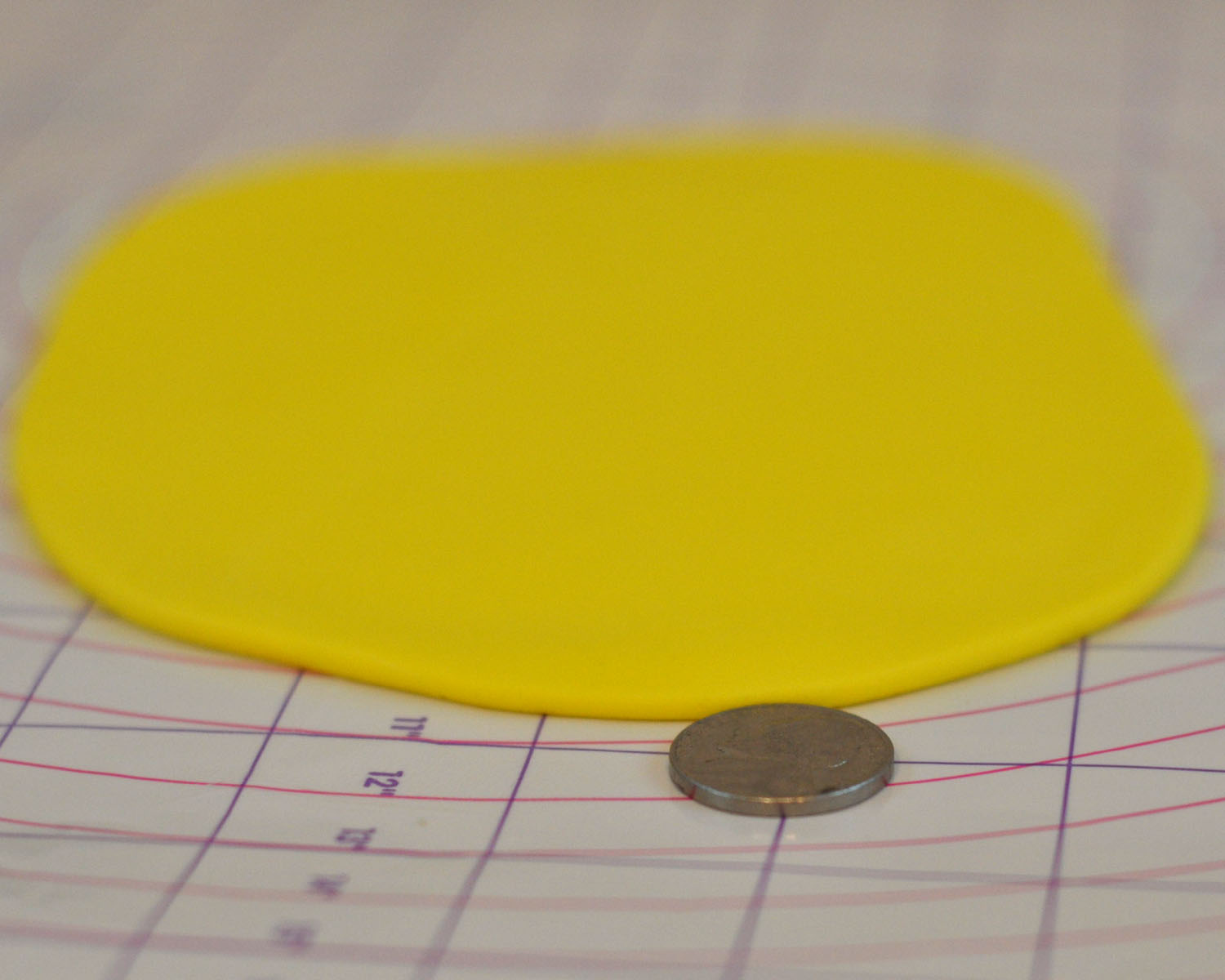
Your fondant should end up between 1/8" and 1/16" inch. That's between the thickness of a nickel and of a dime. If you have a fancy-schmancy rolling pin with its thickness rings, you can use those to keep it all the same thickness. Otherwise, set a coin next to the rolled fondant. If you can run your finger from the fondant to the coin without moving up or down, you're the right thickness.

Whew! Now, you have it all rolled out and cut... time to hold your breath and try to get it on the cake.

If you used a thin rolling mat or parchment or waxed paper, slide your entire arm underneath the mat along the middle of your circle of fondant. Now comes the part I hate... line it up.
You want the edge of the fondant to line up with the bottom edge of the cake... and you want the cake to be centered in the circle (or half-circle as you hold it up) of fondant. Sometimes pulling in a roommate, spouse, sibling, anyone over the age of about 10 to help you line it up can help. They can see it from the side while you see it from the front. (Or maybe you're more capable of lining things up than I am... I hope you are!)

Once you're all lined up, flip the whole kit-n-kaboodle over the cake. Then peel back the rolling mat or the paper.

If you don't want to align it on the mat, you can also wrap the fondant around your rolling pin to get it on the cake. I don't like doing it that way for two reasons: the fondant-covered rolling pin gets really heavy, and you can ding your cake with it. (Which, when you're talking about a few pounds of pin and fondant, really means smash the cake. Yes, I speak from experience.) Also, peeling it off, rolling it around the pin and then re-peeling it increases the chance that you'll stretch or tear the fondant.

If your lining up is less-than stellar, cut some of the extra fondant off from below the cake before you begin to smooth. If you have inches of fondant hanging below your cake, it will be too heavy and pull the fondant to crack at the top edge of the cake. Allow at least 1/4" (or more) to remain underneath the bottom of the cake.

Now, to get it to stick to the cake. Don't try to "eliminate" the wrinkles. The wrinkles will be there. Your goal is to move those wrinkles down below the bottom edge of the cake.
Place one hand horizontally on the side of the cake. (I use my left hand.) GENTLY press the fondant down the side of the cake with that hand, and with the other hand, GENTLY pull the wrinkles down and away from the side of the cake.
I cannot emphasize the word GENTLY enough. Fondant... it will crack. It will tear. So, be GENTLE.

Your cake will kind of look like it's wearing a clingy skirt with a ruffle at the bottom when you've got it all attached and wrinkle-free.

Now, cut off that ruffle. I use clean kitchen scissors or shears. Let the top blade of the scissors brush against the bottom of the board underneath the cake. Using your fingers, again, GENTLY tuck that tiny edge of fondant underneath the board.

See, this is where I should have, I don't know, taken a PICTURE of the finished cake?! No. Why would I do that?! So, you're stuck with this yucky photo of it.
(Although, this is a little preview for you of tomorrow's post... The Great Fondant Comparison. As you can see, I covered numerous cakes with different kinds of fondant for a taste test.)

If you do end up with a lot of wrinkles at the bottom of the cake- and you probably will the first few times you do this, add a big border to the bottom. I made this border by rolling a "snake" like you used to do with Play-Doh, and then you just press it with a round fondant tool... or you could make any kind of design you want. (I'll do a post on more fondant decorating techniques in the future.)

Click the Links Below to See:
Fondant 101: What It Is and How To Use It
Which brand of fondant (or homemade) is best? 
Other Fondant Decorating Ideas and Recipes
Other Basic Cake Decorating Techniques

Enter your email address below to receive the latest recipes, tips and ideas in your email inbox:


Delivered by FeedBurner
Read More
The Great Fondant Comparison

The Great Fondant Comparison

It's the biggest question I get about fondant whether I'm teaching class, or just talking cake with people: Why does fondant taste so bad? Well, I don't really have the answer to that. But I know that there are better and worse kinds of fondant. So, I set out to find out which fondant tastes best. Which fondant is easiest to work with. And which fondant is just the best there is.
(If you want to skip through the details, and just see the winner(s), click here.)

I hosted The Great Fondant Comparison. A highly un-scientific fondant taste test in my home with 7 friends (and  myself) doing the tasting.

I started out with five 'contenders.' I bought three national brands (Pettinice, Satin Ice and Wilton), and made two myself (one from scratch, one with marshmallows). I covered a 6" round cake with each kind of fondant, and made small cut-outs for my taste-testers to try it off of the cake as well.

I then had my testers grade each fondant on appearance, taste, texture and give an overall score. I graded each on its ease of preparation, ease of kneading/rolling, ease/success on the cake, and its cost/availability. Each category got a score from 1-5. 1 meant bad and 5 meant great.

Let's get started!

Ease of Preparation:  
Winner: Wilton

Homemade fondant from scratch:
  The homemade fondant from scratch just takes time, energy and a variety of ingredients that I don't have at home most of the time.
Homemade marshmallow fondant:
  It's a lot easier to make than the scratch fondant, in that all you need is marshmallows, sugar and some flavoring. But there's still a margin of error here, and it's not as easy as opening a box!
Pettinice:
  Yes, you just unwrap it, but this lost a point because I have to go far to get it. It's not carried at a craft or grocery store, You have to buy it online or from a specialty store. Mine is more than 40 minutes away!
Satin Ice:
  Same as above. Not readily available. 
Wilton:
  Readily available at just about any craft store.

Cost/ Availability:
Winner: Homemade marshmallow fondant 
Homemade fondant from scratch: 4.5
  It's less than $7 for 1.75 pounds. However, you do need glycerine, which you need to buy from a specialty or craft store.
Homemade marshmallow fondant:  5
  It's less than $7 for 1.25 pounds. Nothing too weird needed for this one.
Pettinice: 2
  $9.99 for 1.5 pounds, and not available nearby.
Satin Ice: 3
  $13.50 for 2 pounds, and not available nearby.
Wilton: 4
  $9.99 for 1.5 pounds. Wilton fondant is usually available at craft stores, which around here offer weekly coupons for 40-50% off an item, so you could actually buy this even cheaper than you could make your own.

Ease of Kneading/ Rolling: 
Winner: Satin Ice
Homemade fondant from scratch: 1
  I had a hard time kneading the homemade fondant after letting it rest overnight. I believe I did add a little too much powdered sugar this time when I made it, but it wasn't easy to get back to a good consistency.
Homemade marshmallow fondant: 3
  I had a few issues with rolling the marshmallow fondant. It stared off really hard to knead, but then got a little too soft to roll.
Pettinice: 2
  The Pettinice was WAY too sticky. It was hard to handle and stuck to my rolling mat something awful.
Satin Ice: 4
  The Satin Ice was the easiest to roll and knead. It came out of the tub soft enough to work with. It was great.
Wilton: 2
  The Wilton is always hard to knead at first when you get it out of the box. I hear students complain about this all of the time. However, it does roll well, once you finally get it to a smooth consistency.

Ease/ Success on Cake: 
Winner: Tie between Homemade scratch and Satin Ice
(It's too bad I'm not smart enough to have taken photos of each cake after having covered them.) 
Homemade fondant from scratch: 4
  This one looked very nice on the cake.
Homemade marshmallow fondant:  3
  The marshmallow fondant got a little sticky when it got too soft to roll, so it didn't look quite as nice on the cake.
Pettinice: 2
  The Pettinice was so sticky that a lost part of it when it stuck to the mat, so there was a crack on one side of the cake when I finished it..
Satin Ice: 4
  This one looked really great on the cake, and didn't give me too many problems at all.
Wilton: 3
  I have the most experience working with Wilton's fondant, since it's what I use for my classes, but I wasn't as pleased with how it went on the cake as I was with some of the others.

The Fondant Taste Test:
Now you get to hear what the others thought. Below you see small images of our score sheets. Click on them to see them full size, and see the comments and individual scores. I'll give you an average score for each category below.


I started with the cakes in the center of the table, labeled by number. The testers gave each cake an appearance score. I then cut the cakes, and the testers tried them in a random order, so that not everyone would have #1 first. They gave each the other scores along the way, then chose their favorites and least favorites.

Appearance:
Winner: Satin Ice
 (For your reference, #1-homemade scratch is at the bottom in the photo, and #5-Wilton is at the top. You can click on the photo to see the larger image.)
Homemade fondant from scratch: 4 
Homemade marshmallow fondant:  3
Pettinice: 3
The little "fix" I had to do probably dropped the score on this one.
Satin Ice: 5 
Wilton: 4

Taste:
Winner: Homemade scratch fondant

Homemade fondant from scratch: 4
 Comments include: "Not too sweet." and "Good balance of sugar & taste."
Homemade marshmallow fondant:  3.5
  Comments include: "Really delicious on the cake!" and "Chalky aftertaste."
Pettinice:
  Comments include: "Bad aftertaste - metallic." and "Tastes like melted conversation hearts."
Satin Ice: 3.5
  Comments include: "Not sweet enough." and "No taste." and "Tastes almondy." 
Wilton: 3
  Comments include: "Bland." and "Doesn't taste like much." and "Overall good flavor."

Texture:
Winner: Homemade scratch fondant
 Homemade fondant from scratch: 4.5
 Comments include: "Very creamy texture." and "Texture was tough to eat."
Homemade marshmallow fondant:  3
  Comments include: "Not too chewy." and "Great texture."
Pettinice: 3.5
  Comments include: "Melts in your mouth." and "Grainy texture." 
Satin Ice: 3
  Comments include: "Chewy texture." and "Smooth throughout." 
Wilton: 2.5
  Comments include: "Very chewy." and "Reminds me of gum." 

Overall:
Winner: Tie between homemade scratch fondant and Satin Ice
(This is the overall score average from the testers.) 
Homemade fondant from scratch: 4 
Homemade marshmallow fondant:  3.5 
Pettinice: 3
Satin Ice: 4 
Wilton: 3

After tasting them all, each taste tester chose her favorite and least favorite fondant.  
 
Favorite Fondant:
Winner: Satin Ice
Homemade fondant from scratch: 1 vote
Homemade marshmallow fondant:  2 votes
Pettinice: 1 vote
Satin Ice: 4 votes
Wilton: 0 votes

Least Favorite Fondant Votes:
Loser: Pettinice
Homemade fondant from scratch: 0 votes
Homemade marshmallow fondant: 3 votes
Pettinice: 5 votes
Satin Ice: 1 vote
Wilton: 3 votes

THE FINAL SCORES:
To arrive at the final scores, I simply averaged the scores of all of the categories. Now, perhaps I should give more weight to taste than ease of kneading, but when you're making the cake yourself, I care about all of these categories. So... drumroll, please... 
(To see the sheet in full-size, click on the photo.)
Homemade fondant from scratch: 3.375
Homemade marshmallow fondant: 3.375
Pettinice: 2.8125
Satin Ice: 3.8125
Wilton: 3.3125

THE WINNER IS SATIN ICE!!!!
To me, this taste test really was great. It showed me that the pre-packaged stuff can actually be good... if you buy Satin Ice. It also reinforced my belief that taste is truly subjective. With the exception of two, each fondant was someone's favorite and someone's least favorite.

Just a few more thoughts and analyses:

I'm still struggling to say Satin Ice is the best when the homemade scratch fondant won all of the taste categories. But, overall, Satin Ice won more total categories (or tied) than homemade did.

Categories Won: 
Homemade fondant from scratch: 4 wins
Homemade marshmallow fondant: 1 win
Pettinice: 0 wins (except least favorite, but I call that a loss)
Satin Ice: 6 wins
Wilton: 1 win

Then, while writing this post, I wondered... even if a cake was covered with the taste-testers favorite fondant, would they actually eat it? Does all of this work to find the "best" fondant really matter if no one is going to eat it anyway?!
Would You Peel Your Favorite Fondant Off of the Cake or Eat It?
Peel it off: 1 vote
Eat some of it, peel the rest: 6 votes
Eat it all: 1 vote

What Does It All Mean?
Well, given the peel or eat answers... I think it means go with the kind that's cheapest and easiest for you to work with, and forget about the taste. No one's eating it anyway!!

But it was telling to me that no one chose the scratch fondant as their least favorite, and no one had much bad to say about it. But it also was only one person's favorite. (To be fair, I normally would use cream or half-and-half to make it, which makes it a little ivory in color instead of white. I used water to keep it whiter. Perhaps the results would have been different if I'd have used cream.) It also lost points for it's difficulty to make, but I suppose if buying some from a nearby store isn't an option for you, then you may rate that differently.

I also noticed that no one chose Wilton as their favorite. I think based on the responses, it was all about the texture. It didn't taste bad, it just was entirely too chewy. (So, if taste/texture isn't an issue, and you can buy Wilton with a coupon, maybe it's the way to go?!)

Let me know what you think. I'd love to hear if this post was helpful to you! Leave me a comment about your experience with any of these kinds of fondant.

In the interest of full disclosure: NO ONE paid me anything or provided me with anything for this test. I am a Wilton cake decorating instructor, but they didn't give me anything either.

Click the Links Below to See:
Fondant 101: What it is and How to use it 
Fondant Recipes and Decorating Ideas

Enter your email address below to receive the latest recipes, tips and ideas in your email inbox:


Delivered by FeedBurner
Read More